
How do I get my child to learn their times tables?
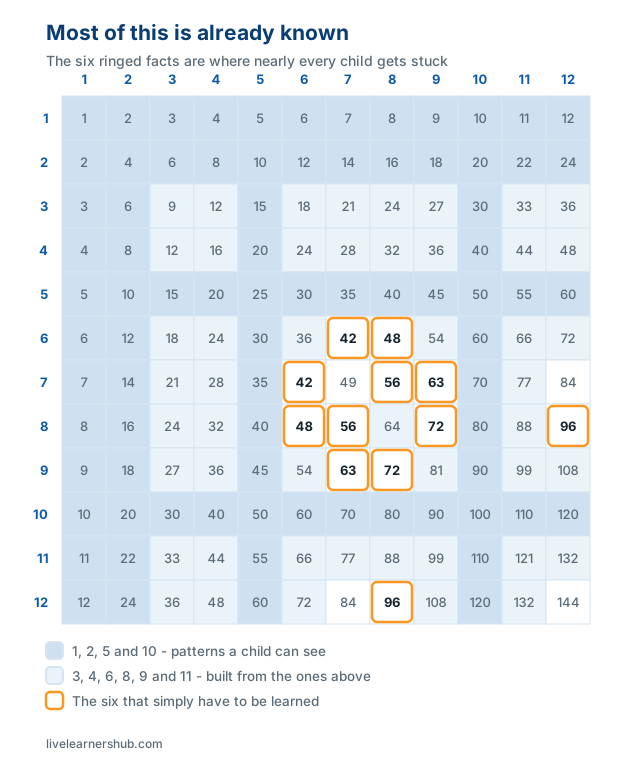
Short, daily practice beats long weekly sessions, and the order matters: 2s, 5s and 10s first, then 3s, 4s and 8s, leaving 6s, 7s, 8s and 9s last. Most children only ever struggle with about six facts. Find those six and you have found the problem.
Times tables are the thing parents are most often asked to help with at home, and the thing most often approached in the way least likely to work: a long session at the weekend, the whole twelve times table, out loud, until somebody is upset. This guide is about why that fails and what replaces it.
Why do times tables matter so much?
Not for their own sake. They matter because almost everything that comes after them assumes they are automatic. Long multiplication, division, fractions, ratio, simplifying, algebra — each of those is a procedure with multiplication facts buried inside it. A child who has to work out 7 x 8 in the middle of a fractions question has used up the attention the fractions needed.
This is why a child can seem to fall behind suddenly in Year 5 or Grade 4 having been fine before. Nothing changed about them. The questions simply started assuming something they never finished learning.
What order should they be learned in?
Not one to twelve. That order is alphabetical thinking applied to something that has an actual difficulty curve.
| Stage | Tables | Why these together |
|---|---|---|
| First | 2, 5, 10 | Patterns a child can see. Doubling, counting in fives, adding a nought. |
| Second | 4, 8 | Doubling again — 4 is double 2, 8 is double 4. Builds on what is known. |
| Third | 3, 6, 9 | 9 has the digit-sum pattern; 6 is double 3. Harder, but still patterned. |
| Last | 7, 11, 12 | 7 has no pattern and has to be learned. 11 and 12 come easily after the rest. |
Roughly the order most primary curriculums use, and the reason is the same everywhere: each stage reuses the one before it.
Why has drilling stopped working?
Usually because of one of these three, and they need different fixes.
- They are reciting, not recalling. A child who can chant the six times table but cannot answer "what is 6 x 7" has learned a song, not a set of facts. The test is out of order, not in order. If the answer only comes by counting up from the start, the chant is doing the work.
- The sessions are too long and too rare. Five minutes on most days will beat forty minutes on a Sunday every time. Recall is built by repetition spaced out, not by time served, and the long session mostly teaches a child that maths is the thing that ruins Sunday.
- It has become about the relationship. Once there have been a few bad sessions, a parent asking a times table is no longer a maths question — it is a question about whether this is going to go wrong again. That is worth recognising, because no technique works through it.
What actually builds recall?
- Work out which facts are missing first. Ask twenty mixed facts, out of order, and write down the ones that are slow or wrong. You will almost always find it is six to ten facts, not a hundred and forty-four. Everything after this is about those few.
- Use the commutative pairs. 7 x 8 and 8 x 7 are the same fact. Saying so out loud halves the work, and a surprising number of children have never been told.
- Anchor the hard ones to easy ones. 6 x 7 is hard; 6 x 5 is easy. Thirty, plus two more sixes, is forty-two. Showing the step is not cheating — it is what fluency looks like on its way to becoming automatic, and the step drops away on its own once the fact is known.
- Five minutes, most days, in an ordinary moment. In the car, walking back from school, while the pasta boils. A deliberate session at a table raises the stakes; a question asked in passing does not.
- Ask backwards as well. "What do I multiply by 4 to get 28?" is the division fact hiding inside the multiplication one, and it is the one the next two years of maths will actually use.
How long should this take?
If it is six or seven missing facts and you do five minutes most days, a few weeks. If it is most of the tables and your child is already in Year 5 or Grade 4, think in terms of a term, and expect it to get easier rather than suddenly click. Anyone promising a number of days has not met your child.
One honest warning about apps: they are good at practice and poor at diagnosis. They will happily drill a child on the tables they already know, because those are the ones the child answers quickly. Doing the twenty-question check yourself first is the part no app does for you.
When is it not really about the tables?
Sometimes the tables are the symptom. If your child also loses track of where they are in a two-step question, or reads 36 as 63, or finds it hard to hold a number in their head while doing something else with it, the multiplication facts are not the place to start. That is worth raising with their teacher before you spend a term on drills — and it is a conversation a school will usually welcome, because they see the same thing in class.
Do we need a tutor for this?
For times tables alone, often not. Five minutes a day from a parent is genuinely the best intervention there is, and it costs nothing. Tutoring is worth paying for when the gap has spread past the tables into the topics that assumed them, when nobody at home has a consistent five minutes, or when the subject has become a fight at home and it helps for the person asking the questions not to be you. If a tutor's first lesson does not find out which facts are actually missing, you have the wrong tutor.
This guide is about Maths. See how 1-on-1 Maths lessons work, and what they cost.