
Phonics, explained for parents
Phonics teaches a child that letters stand for sounds, and that words are built by pushing those sounds together. English has 44 sounds and only 26 letters, which is why most sounds can be spelled more than one way — and why phonics takes two or three years rather than a term.
Your child comes home talking about phonemes and digraphs, the school sends a leaflet full of terms nobody explains, and you are left wondering whether "sounding it out" is something you should be doing differently. This is the short version, with the chart the leaflet usually leaves out.
What are the 44 sounds?
English has about 44 distinct sounds and 26 letters to write them with. That gap is the whole difficulty: one sound can be spelled several ways, and one spelling can make several sounds. Here is the full set, with a word you already say for each.
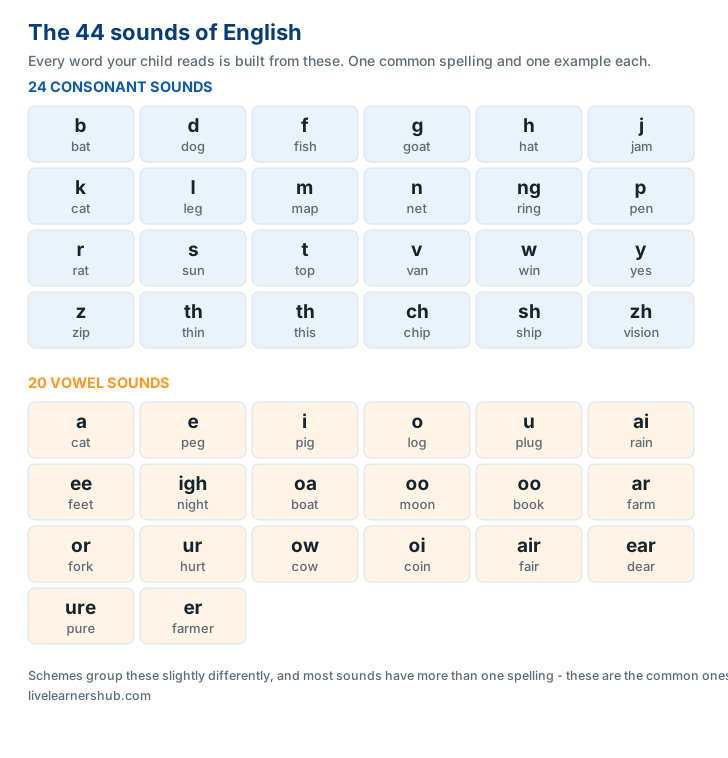
Print it if it helps. The point is not to drill it — it is so that when your child says a word is "wrong", you can see which sound they are actually missing.
What do the words mean?
| Word | What it means | Example |
|---|---|---|
| Phoneme | A sound | ship has three: sh - i - p |
| Grapheme | The letters that spell a sound | sh is the grapheme for one sound |
| Digraph | Two letters making one sound | ch, th, ai, oo |
| Blending | Pushing sounds together to read | c - a - t becomes cat |
| Segmenting | Breaking a word apart to spell | cat becomes c - a - t |
That is genuinely all of it. Blending is reading, segmenting is spelling, and they are the same skill in opposite directions.
How do I help at home?
- Say the pure sound, not the letter name. This is the one that matters most. It is "b", not "buh", and "m", not "em". A child blending buh-a-tuh gets buhatuh and cannot hear bat in it. If you change one thing, change this.
- Let them read books they can actually decode. A book full of words they have not been taught teaches guessing from pictures, which is the habit that has to be undone later. Ask the school which stage your child is on.
- Give them the sound rather than the word. When they stall, say the sound they are stuck on and let them finish. Supplying the whole word ends the sentence and the learning with it.
- Keep it short. Five to ten minutes. A child who is tired is guessing, not reading, and ten minutes of guessing undoes the session.
- Read to them as well. Separately, and far above their reading level. Decoding is the mechanics; this is the reason to bother. Stop doing it too early and you win the battle and lose the war.
A five-minute routine
| What | How long | |
|---|---|---|
| 1 | Three sounds they know, out loud | 30 seconds |
| 2 | Two sounds they are shaky on | 1 minute |
| 3 | Four words using those sounds, blended aloud | 1 minute |
| 4 | A few lines of a decodable book | 2 minutes |
| 5 | You read to them, anything they like | as long as you both want |
Most days beats long sessions at the weekend. The first four minutes are the work; the fifth is the point.
Common mistakes parents make
- Adding the "uh". Said already, worth saying twice. It is the single commonest thing that makes blending impossible.
- Teaching letter names first. Names help with the alphabet song and get in the way of reading. Sounds first; names come anyway.
- Correcting every mistake. Pick the sound you are working on and let the rest go. A child corrected six times in a sentence stops volunteering to read.
- Racing ahead of the school. If they are on stage two and you drill stage five at home, the gap shows up as confusion rather than progress. Ask what they are on.
- Treating it as homework. The moment it becomes a chore with a parent marking it, you have swapped a reader for a reluctant one.
When should I worry?
Children move at very different speeds and most catch up on their own. What is worth raising with the school is a pattern rather than a bad week: still guessing from the first letter after a year of teaching, no sign of blending two sounds together by the end of Reception or Kindergarten, or a child who could read simple words last term and cannot now.
Do we need a tutor for this?
Usually not. Five to ten minutes a day from a parent, with pure sounds and the right books, is the best phonics intervention there is and it costs nothing. Tutoring earns its place in two situations: your child has fallen far enough behind that the class has moved on without them, or reading at home has become a fight and it helps for the person listening not to be you. Both are common, and neither is most families.
This guide is about English. See how 1-on-1 English lessons work, and what they cost.