
How do I help with maths homework without it turning into a fight?
Stop explaining and start asking. A child who cannot say what the question is asking does not have a maths problem yet — they have a reading problem. Work backwards until they can do something, then stop after twenty minutes whether it is finished or not.
Most evenings this goes wrong the same way. Your child is stuck, you explain it, they still do not get it, you explain it again more slowly, and by the third time one of you is annoyed. The problem is almost never the explaining. It is that the explaining started before anybody found out what they were stuck on.
Why does it turn into a fight?
Because by the time you sit down, it has usually stopped being about maths. A child who has been stuck for ten minutes is embarrassed, and an embarrassed child argues. Three things make it worse, and all three feel like helping.
- Explaining the method again. If they did not follow it the first time, the same words slower will not help. They need a smaller question, not a slower sentence.
- Taking the pencil. The moment you write, the work becomes yours. They watch, it makes sense while you do it, and tomorrow it is gone.
- Finishing it so it gets handed in. Understandable at half past eight. But a completed sheet tells the teacher your child understood it, which is the one thing they most need to know is not true.
What to do when they are stuck
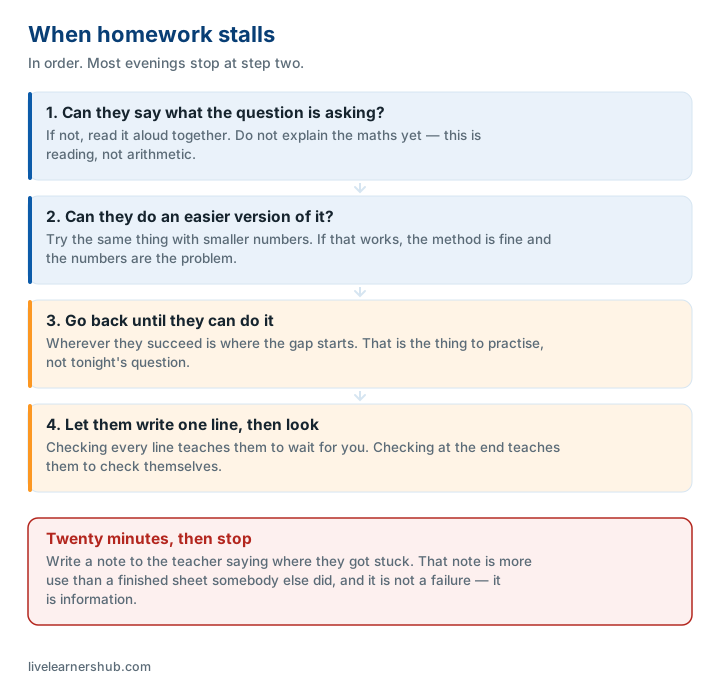
Four steps, in order. Most evenings finish at step two.
- Ask them to say what the question wants. Not the answer — what it is asking for. A surprising amount of "I can't do maths" is a word problem they have not finished reading. Read it aloud together and go no further yet.
- Try the same thing with smaller numbers. If they can do it with 4 and 3 but not 48 and 36, the method is fine and the arithmetic is the problem. That is a completely different evening.
- Go back until they can do something. Keep making it easier until they get one right. Wherever that happens is where the gap starts, and that — not tonight's question — is the thing worth practising.
- Let them write one line, then look. Checking every line teaches a child to wait for you after each step. Checking at the end teaches them to check themselves, which is the skill the exam actually tests.
The twenty-minute rule
Twenty minutes of genuine effort, then stop — finished or not. Write a short note to the teacher saying where your child got stuck.
Parents hesitate over this because it feels like giving up. It is the opposite. A teacher who receives twenty-five completed sheets learns nothing; a teacher who receives one note saying "she could do it with small numbers but not with regrouping" knows exactly what to teach tomorrow. You are not reporting a failure, you are handing over information nobody else has.
What if I do not understand the method?
This is the commonest reason parents stop helping, and it is not the obstacle it looks like. Primary maths is taught differently now — number lines, part-whole models, column methods introduced in a particular order — and your way usually gets the right answer by a route the class has not reached yet.
You do not need the method. You need the four questions above, none of which require knowing how the school teaches long division. If you want the method, ask your child to teach it to you — genuinely, not as a trick. Explaining it is how they find out whether they have it, and it puts them in the one position they are never in during this conversation: the one who knows.
Common mistakes
- Starting when they are already upset. Nothing works through tears. Ten minutes away from the table costs less than an hour of fighting.
- Doing it at the same table as the argument about something else. Children attach rooms to feelings faster than adults expect.
- Saying "I was bad at maths too". It is meant kindly and it lands as permission to stop trying. Say "this bit is hard" instead — it is equally true and points somewhere.
- Correcting the layout while they are thinking. Untidy working that gets there beats neat working that does not. Fix presentation another day.
- Making it the last thing before bed. The tiredest half hour of the day is the worst one to spend on the subject they already dread.
Do we need a tutor?
Not for the occasional difficult night. The four questions above are most of what a tutor does in the first ten minutes anyway, and they cost nothing.
It is worth paying for when the gap has spread — when going back to something they can do means going back two years, not two steps — or when homework has become a fight that is damaging something more important than maths. In that second case the value is not the teaching. It is that the person asking the questions is no longer you.
This guide is about Maths. See how 1-on-1 Maths lessons work, and what they cost.